FULL CERTIFICATE
The Gold Standard Program
Welcome to the multibillion-dollar meetings and events industry. This module presents the big picture of the global meetings and events industry and how the industry impacts destinations, tourism and business through people gathering and meeting. The business is about people and how the power of meetings and events influence, inspire and effect change in the world. This perspective will inform your career choices and help in making solid business decisions for those you work with and for.
(Estimated time: 30 minutes)
What You Will Learn
- Introductory Module 1 for free
- A customized workbook to accompany each Module
- An assessment following each Module to challenge what you learn
- Monthly Town Hall Meetings with Dianne
- Option to participate in a Video Community
- Exclusive interviews with industry professionals specializing in each Module area
- Membership in a branded online community of professionals
Description and Content for all 19 Modules included in the Certificate


MODULE 1
Introduction and Industry Overview
Welcome to the multibillion-dollar meetings and events industry. This module presents the big picture of the global meetings and events industry and how the industry impacts destinations, tourism and business through people gathering and meeting. The business is about people and how the power of meetings and events influence, inspire and effect change in the world. This perspective will inform your career choices and help in making solid business decisions for those you work with and for.
(Estimated time: 30 minutes)
What You Will Learn
- The power and influence of the meetings and events industry
- The business value of meetings and events
- The types of meetings and events
- The different roles and responsibilities for those involved in the meetings industry
- How the media supports the meetings and events industry

MODULE 2:
Business Theory and Application
(Estimated time: 1 hour 30 minutes)

MODULE 2 BUSINESS THEORY AND APPLICATION
No More Useless Meetings!
Meetings and events are integral to any business and, because of this, understanding and applying business theory and concepts is a best practice for the planner in working with various stakeholders. From concept to completion, utilizing steps and procedures to support the purpose of the event helps keep everyone focused on successful outcomes. Learning different business terms, and how analyzing and strategizing prior to the event gives direction and purpose to gain maximum results, is the basis for any successful event.
(Estimated time: 1 hour 30 minutes)
What You Will Learn
- The process involved to identify the objectives and goals
- What questions to ask to understand a client's vision
- Tools including SWOT analysis and The 4 Pillars of Event Management and their critical roles
- The Event Management Cycle and how each stage plays a vital part in planning
MODULE 3 SOURCING AND SITE SELECTION
Finding the Right Fit Affects Everything
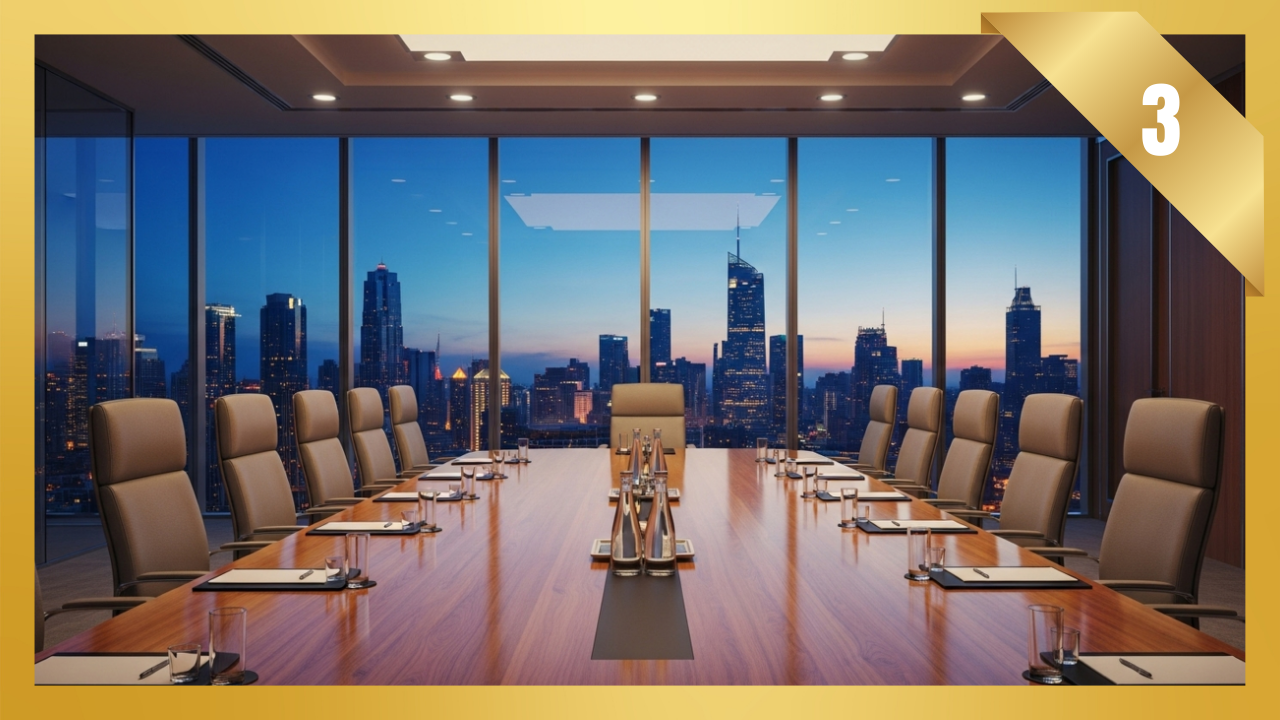
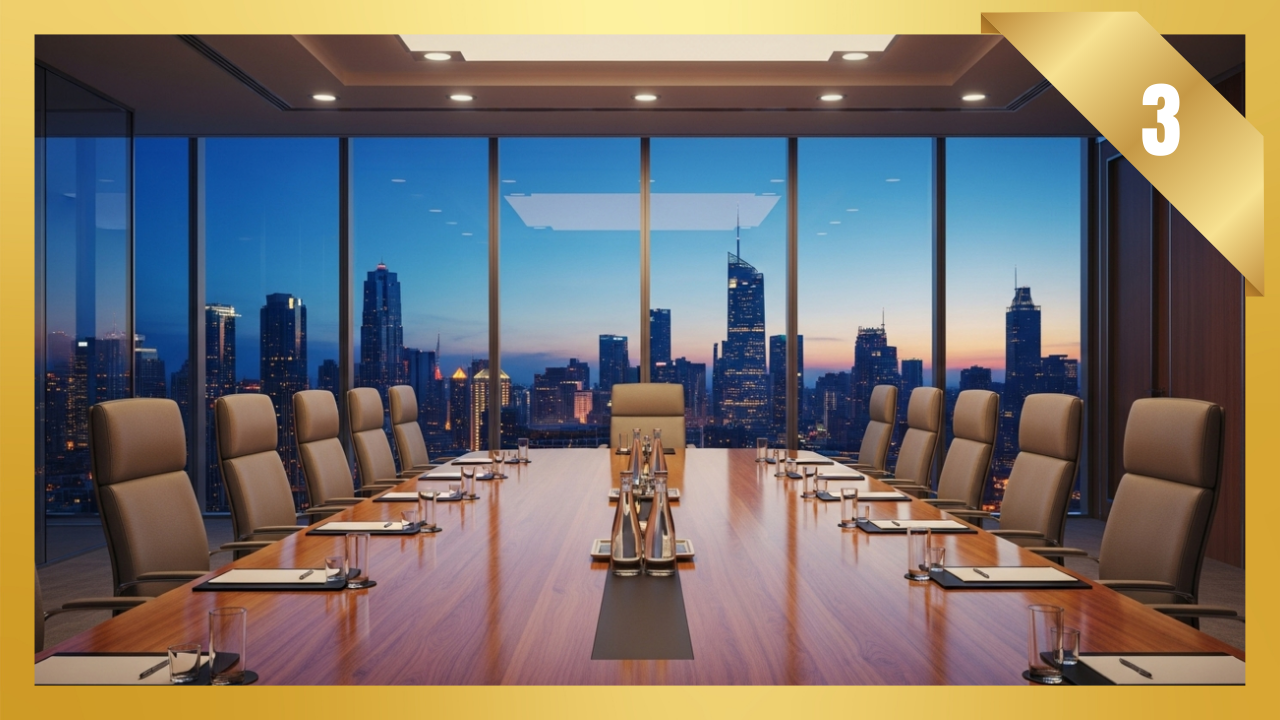
Where the meeting or event is held is critical to its success. The venue is the stage and, to create a successful production, the hotel or space must meet certain criteria to meet the needs of the event. Sourcing and site selection is a detailed and legal process involving contract negotiations. To find the right location, the planner must be organized, know the agenda and the content, to maximize the benefits of a well-structured sourcing and site selection process. Learn the steps, including the request for proposal (RFP), of sourcing and site selection to find a suitable location. Choices regarding hotels' day conference centers have elements that impact meetings' success. Options for virtual site visits are presented, along with the role they play in big picture design and room setup.
(Estimated time: 2 hours 30 minutes)
What You Will Learn
- How to source, and to reduce risk, using a professional third-party site selection company
- How to prepare for an in-person site visit
- How to accommodate people with different abilities
- The options and benefits of day conference centers
- How room setups affect meetings' outcomes
- Questions to ask during the RFP and contracting process
- Contract negotiations and what is expected in the process


MODULE 4 FREELANCE STAFF
Creating Your Onsite Support Team
Well-executed events cannot be done solely from a logistical and risk management viewpoint. Fortunately, along with a generation of well-trained, experienced planners, the rise of professional freelance staffing in the meetings industry has grown exponentially to meet the planners' need for highly qualified professionals to perform specific tasks and contribute to the success of the meeting or event. Learn the steps, guidelines, pitfalls to avoid and what is required to working with a professional company to manage freelance staff.
(Estimated time: 1 hour)
What You Will Learn
- How to work with a professional freelance staffing company
- What to look for in a freelancer
- How freelancers support meetings and events from pre- to post-event planning
- How to develop an efficient and effective freelance program
- How to minimize risk and the legalities of working with freelancers


MODULE 5 VOLUNTEERISM
Consider Yourself One of Us!
Volunteers are the very essence and workforce behind many associations, non-profits and major events. Learn how to develop solid volunteer programs to recruit, manage, retain, and recognize this important labor force. Examine the value that volunteers add to your program by decreasing staffing costs, being brand ambassadors, building a loyal community for those involved. Whether a high-level sporting event, political event or a non-profit, how you develop, manage, and recognize volunteer staff is important to its success.
(Estimated time: 1 hour)
What You Will Learn
- What is involved in a volunteer program
- How to recognize volunteer talent
- The three stages of volunteerism and how they never end
- How to design a volunteer program
- How to manage volunteers
- How to minimize risks of working with volunteers


MODULE 6 SUSTAINABILITY AND GREEN EVENTS
Repurpose, Reuse, Reduce!
The importance of sustainability in meetings and events is important and is a growing requirement for companies and business operations. In meetings and events, from ballroom to exhibit floor, choosing venues, partners and stakeholders who share mutual values and vision is vital to smart business decisions. The awareness of how sustainable and green practices play a vital role in meetings and events is growing, and planners have the responsibility to make choices that affect our future together.
(Estimated time: 1 hour)
What You Will Learn
- What are green and sustainable events and who supports them now
- How green events affect the environment and save money
- What are the different categories of green events
- What sustainability questions to ask when sourcing sites and materials
- How to choose a meeting or event site based on its green certification
- How luxury brands add lasting value

MODULE 7:
Registration and Data Responsibility
(Estimated time: 1 hour 30 minutes)

MODULE 7 REGISTRATION AND DATA RESPONSIBILITY
Let Me Know if You're Coming
A first impressions and marketing tool for the planner, the attendee registration process is operative and front-facing from pre- to post-event. Registration provides countless opportunities for engagement as planners use registration tools to streamline processes from logistics to event marketing. Registration must also ensure data privacy while tracking key performance indicators (KPis) to prove impact to key stakeholders. From strategy to logistics of an onsite Registration area, this important element of planning can make or break an event's impact and success.
(Estimated time: 1 hour 30 minutes)
What You Will Learn
- The purpose and opportunities involved in the registration process
- How to define needs and strategize content when designing a registration platform
- The importance of registration during each phase of an event (i.e., before, during, and after an event) and key questions to ask
- How to set up an efficient onsite registration area
- Learn how the planner is responsible for the use and protection of attendee information


MODULE 8 FOOD, BEVERAGE AND CATERING
Let Thy Food be Thy Medicine
If Hippocrates were alive today, he would be excited to see how food commands the attention of the meetings and events industry based on its qualities, effects on behavior, and core purpose of nourishing people for energy and sustenance. People have broken bread together since the beginning of time. Food plays critically important roles in any gathering—it is deeply connected to the social and physical well-being of every attendee. Food serves multiple purposes. In meetings and events, food is a brand and theme component, can entertain, and provides memorable and lasting sensory experiences. It creates opportunities for attendees to meet and to share ideas and fellowship. Not only is it a planner's responsibility to create balanced menus, but a planner must also be sensitive to the dietary needs of all attendees. All of this applies to beverage, too!
(Estimated time: 2 hours)
What You Will Learn
- Why a planner must understand the risks and liabilities associated with serving specific foods
- How to determine and accommodate the dietary needs of attendees
- All about the structure and hierarchy of a catering team
- How to work with caterers anywhere
- What are the different food styles
- Food as an event theme
- The role of food and beverage and themes


MODULE 9 TRANSPORTATION
Let the Wheels Keep on Turning!
From the Silk Road to the High Road, transportation has always played a big role in bringing people together for meetings and events from old-time carriages to today's space tourism initiatives. Bringing people together to enjoy a specific destination requires much coordination on many levels from the executive level to all attendees, from local travel to international travel. Effective transportation management is the process of managing moving people from point A to point B safely, efficiently, and dependably. It also involves moving meeting and event equipment and materials. The planner has a responsibility to understand how to manage transportation and all the details involved from chartering and booking vehicles, what vehicle choices exist and how to work with transportation management companies to reduce risk. This subject is not something to skip learning about and it will surprise you.
(Estimated time: 2 hours)
What You Will Learn
- The role of transportation in meetings and events
- Why transportation is important to meetings and events
- How transportation can support a theme and provide entertainment
- Transportation management including forms and communication
- The role of air, trains, boats, and cruise lines
- How to accommodate attendees with different abilities
MODULE 10:
Audio Visual and Production
(Estimated time: 2 hours 30 minutes)
MODULE 10 AUDIO VISUAL AND PRODUCTION
See Me, Hear Me, Teach Me
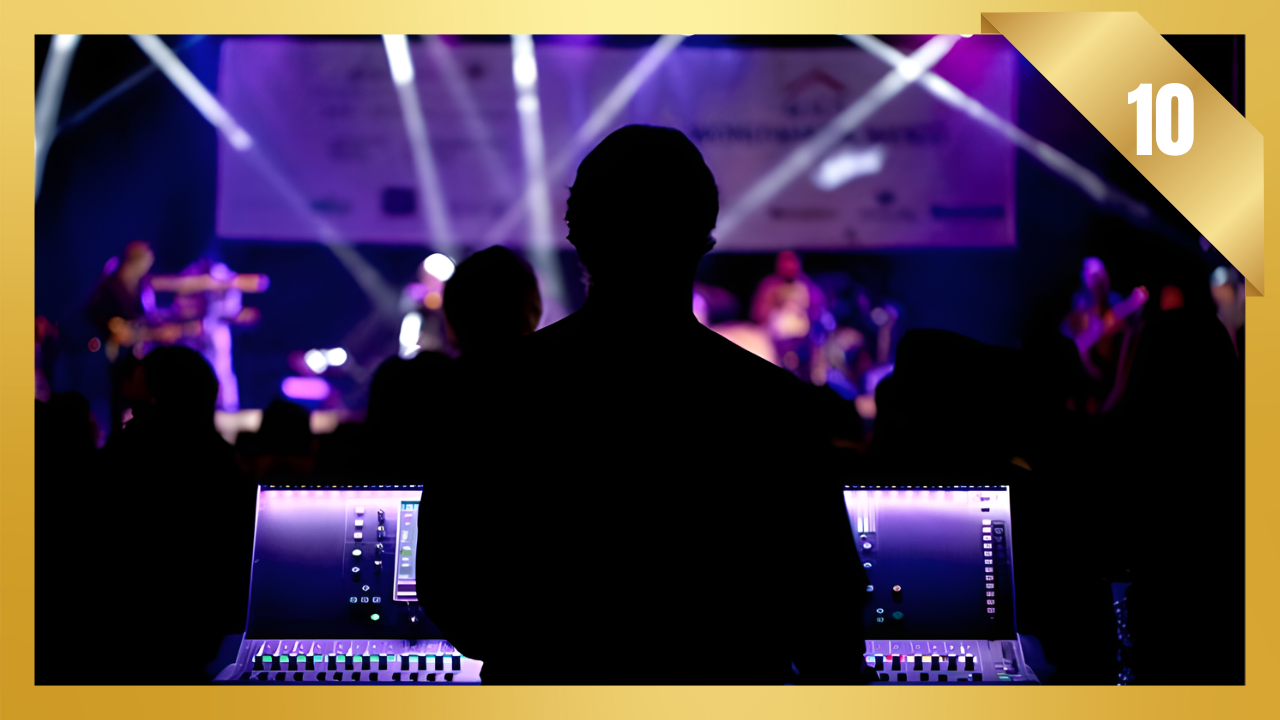
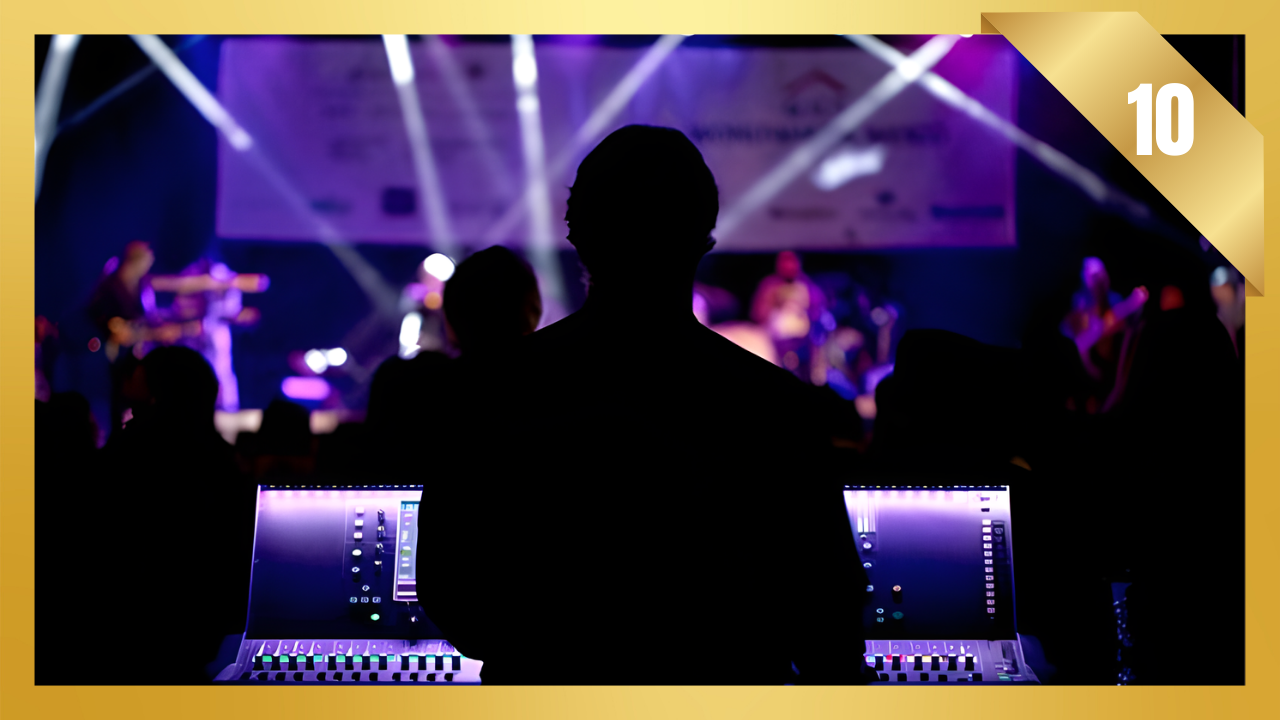
Welcome to the Theater of Meetings and Events! When the curtain goes up and the lighting and sound are subpar, then the audience is distracted, chaos blows up, and the success of the event is instantly jeopardized. Behind every curtain (or monitor) is a team of seasoned professionals who specialize in audiovisual production comprising both services and content. It is important for the planner to understand the AV team's needs and to work with them throughout the entire event planning stage. They know that what you see and hear, and how, are vital to an event's success. Audiovisual production is a major component that conveys a message, establishes mood, creates the desired effect in a meeting or event environment. Whether in-person, virtual, or hybrid, audiovisual production is essential to deliver consistent content on demand globally. Always make choices that reduce risk you do not want to be the planner in the room when the power or internet connection goes out.
(Estimated time: 2 hours 30 minutes)
What You Will Learn
- How a multimedia approach brings your event to life using lighting, sound, staging, and event scripting
- The difference between audiovisual services and audiovisual production content
- The importance of audiovisual in the site selection process
- How staging and room setup affect the room and guest interactions
- How lighting and color play a vital role in branding and decor
- How an AV team works, accommodating speakers and special needs
- How to manage the risks associated with an audiovisual production
MODULE 11 EVENT DESIGN & DECOR
Translating the Vision and Message
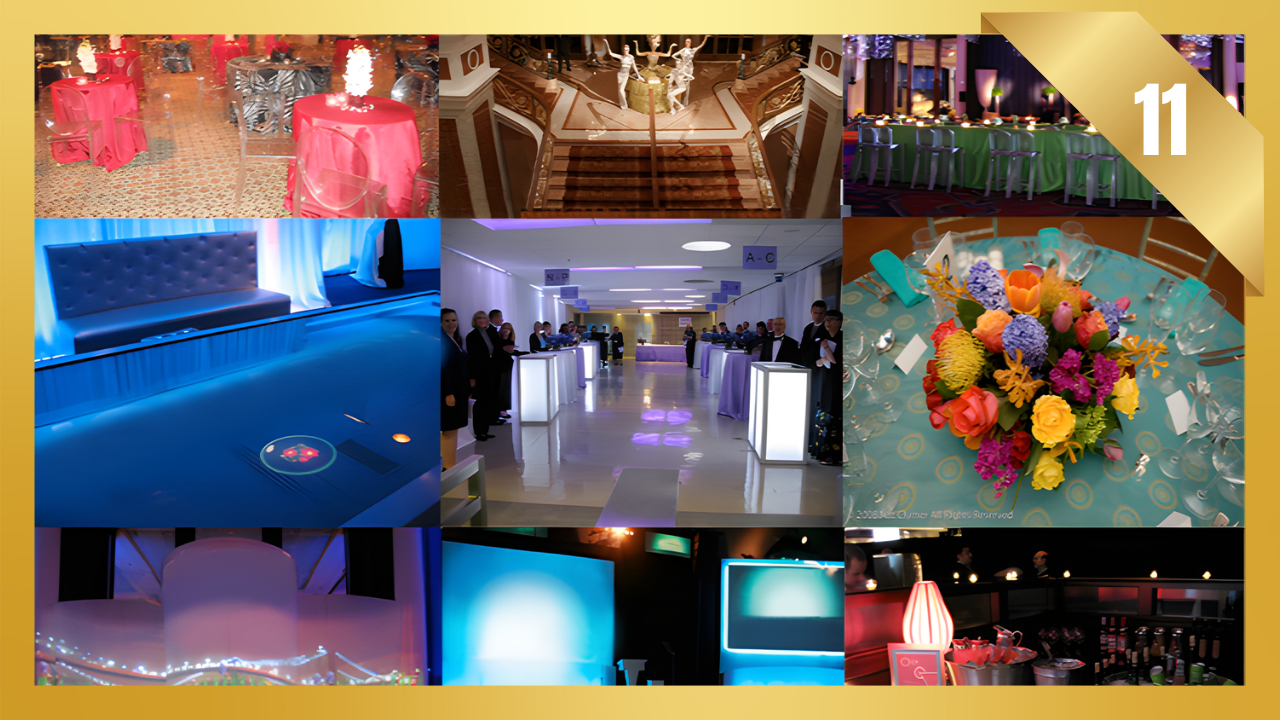
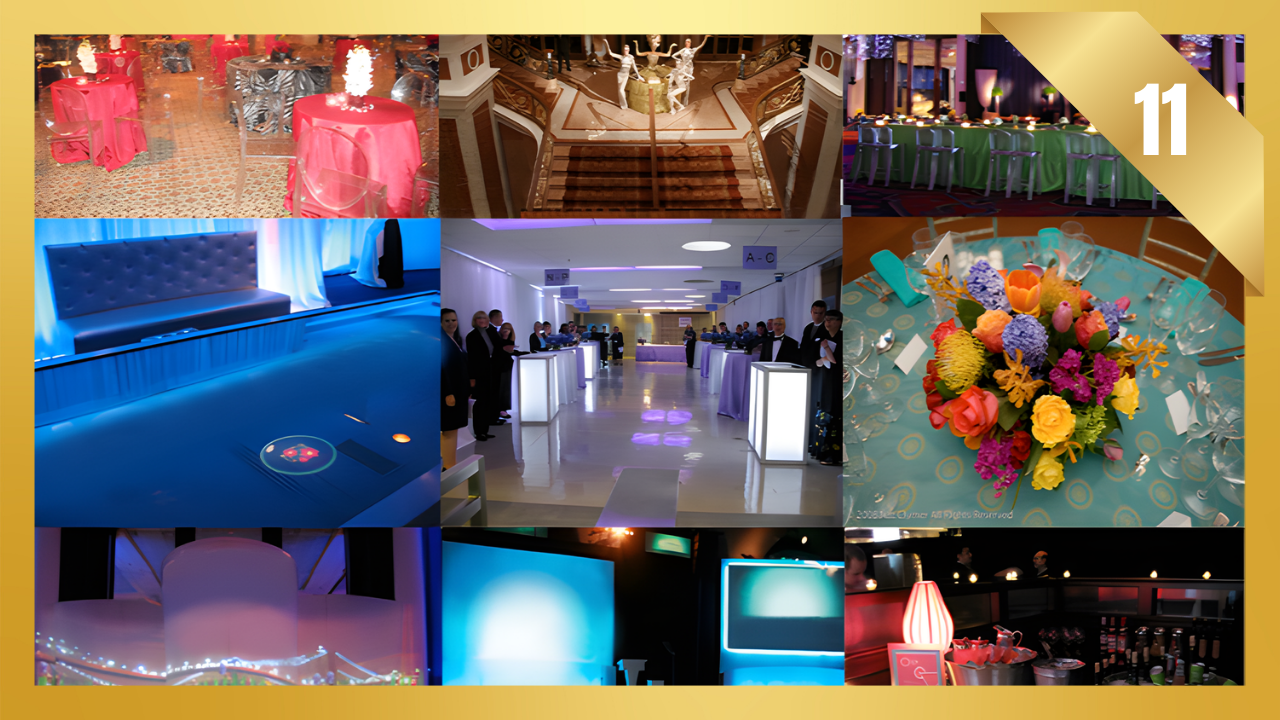
Everything—absolutely everything—that takes place during an event, whether in person or virtual must be a deliberate choice that supports the overall vision. Visual dynamics and engineering are major aspects of effective event design and decor. The ability to put all the pieces and people together, to understand the big picture, the vision and process, and to transform them into a tangible sensory experience for measurable results is the responsibility of event design. Effective design, choosing intelligently among the variety of experiential elements, delivers a stronger message through understanding the business strategy behind it, making it a vital part of communication.
(Estimated time: 2 hours 30 minutes)
What You Will Learn
- How design begins with understanding objectives and goals
- How all the elements of design are deliberate choices to be made based on circumstances and criteria
- How design is a communication tool and how to use decor to support the vision
- How themes play an intrinsic role in design
- How the senses react to design choices and increase engagement
- How space, special effects and style affect flow, movement and interaction

MODULE 12:
Music Entertainment & Speakers
(Estimated time: 1 hour 45 minutes)

MODULE 12 MUSIC ENTERTAINMENT & SPEAKERS
I Hear You, I See You, I’m Listening to You
We share in common languages of verbal and nonverbal communication, and nothing plays a more important and inspirational role in this in events than the use of music, entertainment and speakers (MES) to bring us together. As powerful tools that shape a theme, drive a message, and add diversity to events, these have a dramatic effect on an event's outcome, attendee behaviors, team building, mental health and just plain fun and interaction. When they are strategically used for control and concentration, events can be managed to reap desired results.
(Estimated time: 1 hour 45 minutes)
What You Will Learn
- The strategic purpose of MES in events of music, entertainment and speakers (MES) in events
- Why MES add value, awareness and increases productivity
- The global array of choices in MES
- How to define objectives for MES
- How to source MES
- How music and entertainment can be team building tools
- How to buy talent and calculate talent costs
- What is music licensing and how it affects event planning
MODULE 13 EVENT MARKETING AND SPONSORSHIP
Eat Your Ps Please!
Regardless of all the time, energy and resources invested in planning and producing an event, without people, there is no event. Event marketing is a time-sensitive process that uses focused, purpose-driven strategy to communicate to a specific audience: COME, this is what we're promising. Whether you are promoting a brand or launching a new product or service—it is a major responsibility to inform and influence, generate buzz and engagement, and excite and energize people to respond and participate.
(Estimated time: 2 hours)
What You Will Learn
- The purpose of event marketing
- How video marketing and establishing community-driven videos increase return
- The P’s of event marketing from product to participation
- How to deliver “the message” using touch points
- How promotional items, invitations and use of premiums support a theme and brand
- The function and role of event sponsors
- How to recognize and develop sponsorship opportunities
- The correlations among advertising, public relations, meetings and events and event marketing
MODULE 14:
Production Schedules and Budgeting
(Estimated time: 1 hour 45 minutes)
MODULE 14 PRODUCTION SCHEDULES AND BUDGETING
The “Big Picture”
Regardless of what you do in life, it costs either time or money and it is no different for events. As communication tools, meetings and events have time constraints, real costs and a need to keep all stakeholders in sync. The planner needs to realistically understand time management, attendees and their expectations, and event content to make attainable decisions and appropriate choices. Staying on task and on budget requires careful planning and strategic communication with all stakeholders involved in the production of an event so that tasks are completed in the most cost-efficient and timely manner.
(Estimated time: 1 hour 45 minutes)
What You Will Learn
- The purpose of a timeline as a guide and working tool
- Using the Event Management Cycle to create a timeline
- The role of production schedules for all stakeholders at an event
- The Five Stages of Budgeting as a business tool
- How to identify costs, manage cash flow, and track spending history when creating a budget
- To understand different types of expenses and accountability for independent or in-house planning
- The importance of gratuities in meetings and events

MODULE 15:
Risk Management, Safety and Security
(Estimated time: 1 hour 30 minutes)

MODULE 15 RISK MANAGEMENT. SAFETY AND SECURITY
Plan B: B Prepared!
STOP here. The planner's most important responsibility is to ensure the safety and security of all event stakeholders. From environment to vendors, the planner must devise a plan that anticipates and addresses anything that could go wrong. Understanding the role that a professional security consultant and company play in meetings and events is critical for the planner, regardless of type or size of event. The planner must ensure a safe environment, and reduce any risk throughout the entire planning and design process—people, health and safety always come first.
(Estimated time: 1 hour 30 minutes)
What You Will Learn
- How to identify risks—internal, external, environmental, and epidemic
- Understand the difference between risk management, safety and security
- Understand the client's security needs from pre- to post-event
- How to prepare for disaster and what steps to take with all vendors and stakeholders
- How to work with professional security consultants and companies and why
- When to use a permit and/or license in planning events.
- Cyber-security and the GDPR act
- How to create a safe environment


MODULE 16 LEGAL ASPECTS
The Causes and the Clauses!
Be aware, and beware. Adhering to legalities and compliance is a major responsibility from the onset of event planning; sourcing a site, choosing vendors, etc.—all require contracts and agreements. Planners must know the legal implications of all tasks and activities for an event, and act according to the proverb “trust, but verify.” From the request for proposal (RFP) onwards, proposals and contracts must be understood so that the planner can ensure that all parties are protected from harm to their person and their purse.
(Estimated time: 2 hours)
What You Will Learn
- How to establish “best practices” for an event
- Why written proposals, agreements, and contracts are paramount and what each should address
- How to ask for concessions, and negotiate strategically, beneficially
- What clauses to include in a contract
- When to use an Indemnification clause
- How to interpret a proposal and contract
- What an addendum and rider are, and the protocol for each
- How to organize information for access and legal protection
- To understand general legal concerns for logos, intellectual property and risk elements in events
MODULE 17 INSURANCE
If Anything Can Happen … It Will!
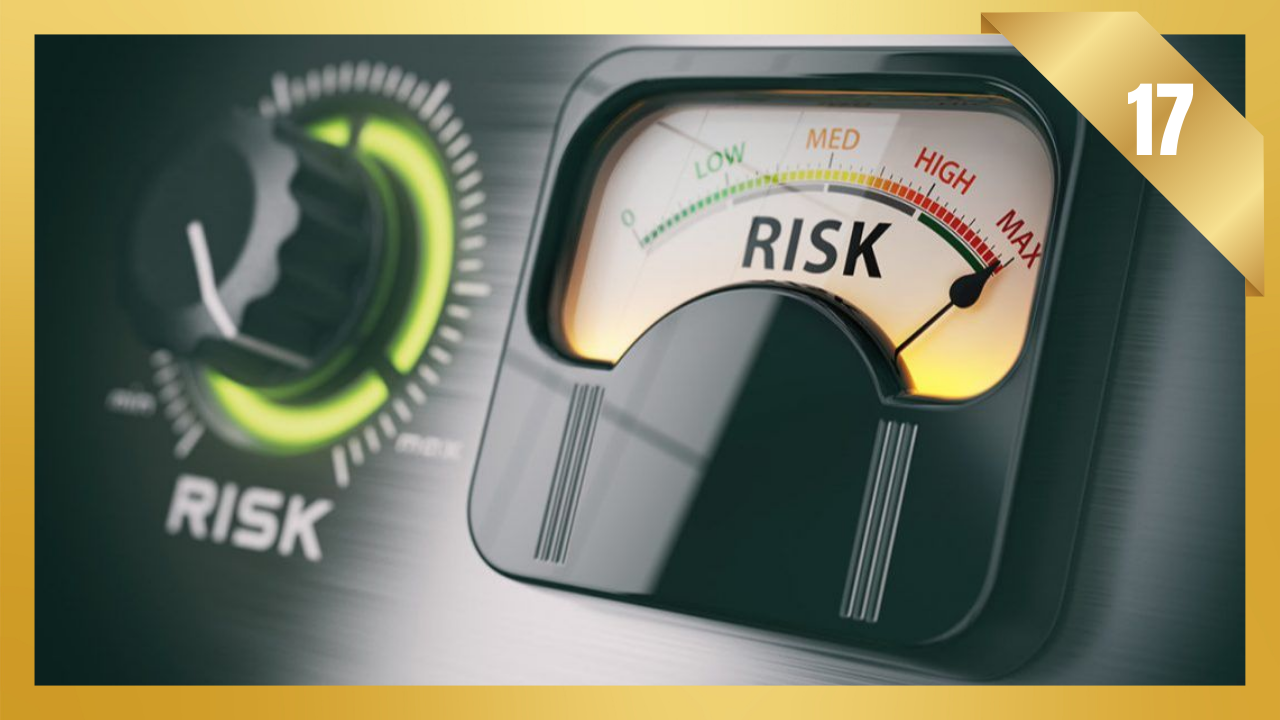
At one time, the insurance industry didn't understand all the risks involved with meetings and events. Imagine describing some in-person events with exposed flames in candles, transporting people in vehicles in all kinds of weather, booking air, transporting heavy equipment, food and beverage, recreational activities like hot-air balloons and tug-of-war and so on. The role of insurance and the different types of insurance are not optional. Liability is the planner's responsibility, period. Despite each event's inherent differences, there are common precautions that a planner must consider. Being prepared for “what if” will put your clients at ease and allow you to create with confidence.
(Estimated time: 1 hour)
What You Will Learn
- Why you need insurance for each and every event
- What are the types of insurance and the protections they provide
- Who is covered by a policy and why you may need more than one
- The responsibility all vendors have for insurance and how they can protect you
- The difference between a certificate of insurance and an insurance policy
- How to assess a creative decision based on the risk factors involved


MODULE 18 TACKLING TECHNOLOGY
Man or Machine—Who is in Control?
Whether to use high tech was once the choice; now the choice is which technology to use for maximum return and ease of use. Meetings and events play such an important role in collecting data from targeted groups of people for marketing and research purposes but, for the planner, technology is a tool to help market, manage and manipulate data during the planning and production process whether for in-person or virtual events. Understanding the choices, and why and how a platform can serve the planner, is critical in every phase from pre- to post-event, from registration to surveys and follow-up. Knowing and acting on what is relevant, secure and appropriate is tantamount to an event's success and participant engagement. The use of technology has elevated events to stratospheric heights. Gone are the days when events are confined within four walls. Learn how planners now use technology to reach massive audiences, to deliver a message and create memorable, impactful experiences.
(Estimated time: 1 hour 45 minutes)
What You Will Learn
- How to identify the best technology platform for a meeting or event based on event criteria
- How technology affects sourcing and site selection through virtual experiences
- How special tools like mobile apps provide alternatives for delivering information
- How on-site kiosks and touch screens aid flow and momentum at an event
- Why a planner is responsible for advising stakeholders about their various technology options
- How to choose the right technology for the event environment and attendees, and to deliver the message of the event
- How a single technology platform can facilitate several event functions—e.g. event marketing, registration, seating
- How to protect data and reduce risk in using any technology


MODULE 19 FAST FORWARD
The Best Way to Predict the Future is to Create It
Technology is transforming the world, and how we do business, at an accelerating pace. More than ever, the planner must know what's new, what's next, and what's effective in planning and managing meetings and events. Evaluating the objectives and goals of meetings and events, and advising the best vehicle to use to implement and execute them, is requisite to maximize results. From employing artificial intelligence during planning to executing an event, our choices continue to grow. Understanding the benefits and pitfalls of AI, AR (augmented reality) and virtual reality, and how they may impact our work and our lives, is imperative. Planners are responsible to think both dimensionally and realistically when designing an event in real-time while directing stakeholders to collaborate in decision-making. The managed use of technology and communications is a challenge that unlocks higher achievement and greater accomplishment when global stakeholders are empowered to jointly contribute to the outcome. Additionally, we will offer a high-level review of all 19 module topics that are included in the Certificate program, to refresh your memory of key information and to spark fresh insights.
(Estimated time: 2 hours 15 minutes)
What You Will Learn
- The principal concept that we will always meet, but how we meet will constantly change
- Where we are today with technology and where we are heading in the future.
- AI, AR and VR: What they are, and how they can be employed for meetings and events.
- Understanding the principles behind having a vision and embracing innovative technology.
- What a Digital Twin is and how this concept helps the planner in the pre-, onsite and post-event stages of the event cycle.
- A review of all 19 modules and their key concepts.
CHOOSE FROM FOUR BUNDLES
BUNDLE A
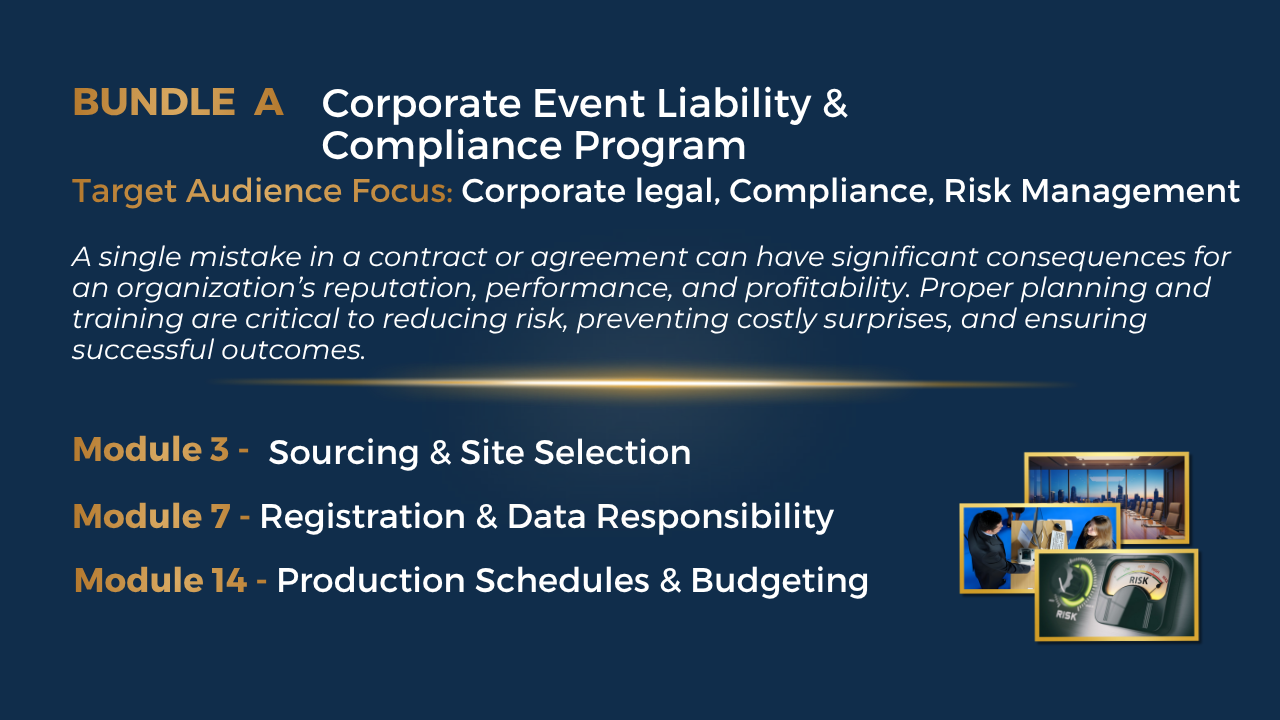
Corporate Event Liability & Compliance Program
(Modules 3, 7 and 14)
BUNDLE A
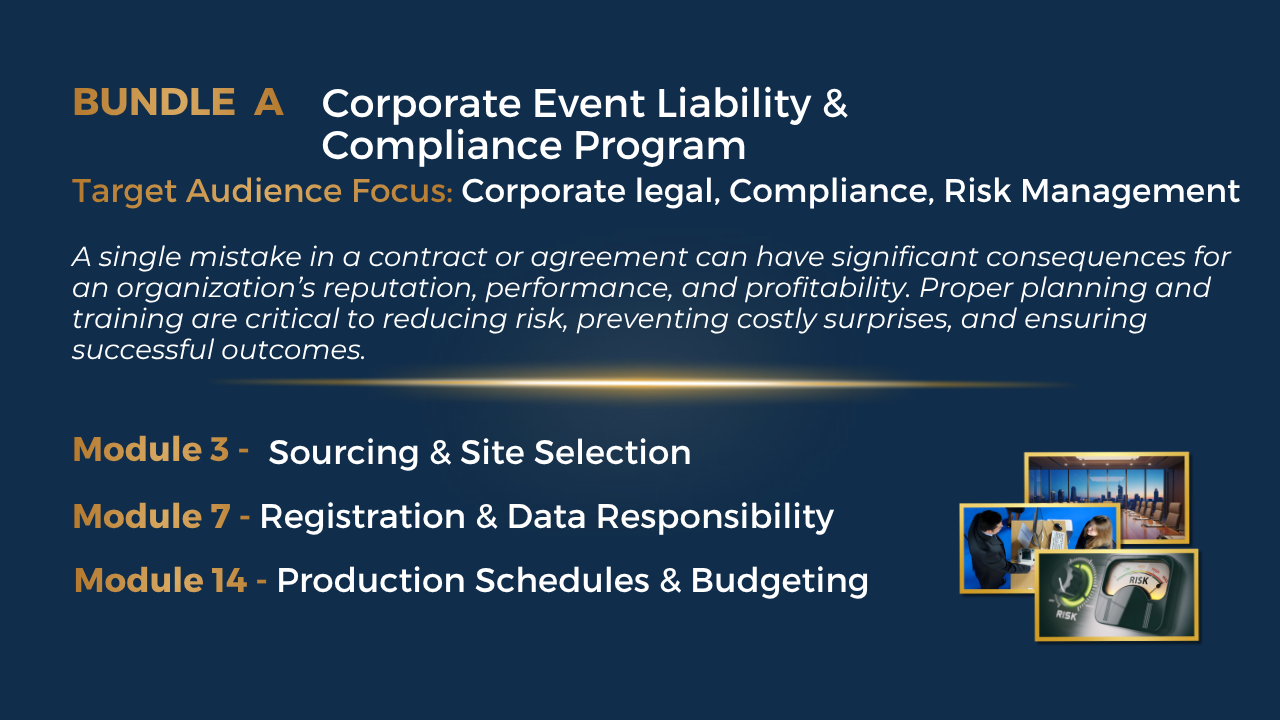
Corporate Event Liability & Compliance Program
👤👤Target Audience Focus: corporate legal, compliance, risk management
A single mistake in a contract or agreement can have significant consequences for an organization’s reputation, performance, and profitability. Proper planning and training are critical to reducing risk, preventing costly surprises, and ensuring successful outcomes.
(Modules 3, 7 and 14)
Why it Matters to Legal
- Module 3: Sourcing & Site Selection Sourcing a location is a strategic decision to the success of the event. The location is about logistics, the look about branding and the venue contract is filled with negotiation, concession and contain hidden liability. This teaches what to look for before signing.
- Module 7: Registration & Data Responsibility Registration is not about name tags. It is about collecting and managing data for various purposes. The right platform protects against data breaches from attendee information.
- Module 14: Production Schedules & Budgeting Schedules and accountability are critical to creating financial audit trail and spending controls. Maintaining team collaboration and deadlines have cascading effects on building, tracking, and final reconciliation.
BUNDLE B
Risk, Legal and Insurance Essentials Program
(Modules 15, 16 and 17)
BUNDLE B
Risk, Legal and Insurance Essentials Program
👤👤Target Audience Focus: Procurement, Operations
Every event carries legal, financial, and operational risks that can impact an organization's reputation, results, and bottom line. Planners need awareness and knowledge to make informed decisions, avoid costly mistakes, and protect organizational interests.
(Modules 15, 16 and 17)
Why it Matters to Legal
- Module 15: Risk Management, Safety & Security People first. Compliance with duty of care for attendee safety and security is number one priority. Learn to take precautions to avoid unnecessary crisis that can also become a PR disaster.
- Module 16: Legal Aspects The nearly trillion-dollar business of meetings and events is based on contracts, agreements and legal implications. This covers force majeure, indemnification, cancellation clauses.
- Module 17: Insurance There are many types of event insurance that many agencies or small companies skip. These include General Liability, event cancellation insurance, rented equipment coverage. Know what to protect to ensure proper certificates of insurance and additional insured status.
BUNDLE C
Marketing, meet Execution
👤👤Target Audience Focus: marketing or branding agencies, or corporate marketing departments
Great branding gets remembered. Operational failures get remembered longer. Events combine countless moving parts that shape audience perception, and a single breakdown can undermine months of marketing, planning, and brand-building efforts.
(Modules 3, 11, 12 and 13)
Why Marketers Need It
- Module 3: Sourcing & Site Selection Sourcing a location is a strategic decision to the success of the event. The location is about logistics, messaging and branding. The venue contract is filled with negotiation, concessions and contain hidden liability. Understanding power, permits and planning needs attention and what to look for before signing.
- Module 11: Event Design & Décor Messaging, options, and design choices are integral to the event’s success. Like an advertising campaign, copy, visual dynamics, flow and design affect the event’s outcome.
- Module 12: Music, Entertainment & Speakers Marketers book talent, speaker and music to reinforce messaging, drive involvement, create environments. Behing the scenes, knowing contracts, riders, cancellation terms, and rights usage is required.
- Module 13: Event Marketing & Sponsorship You may know marketing, but event marketing offers different options. This module is useful for sponsorship fulfillment — delivering what was promised to partners.
BUNDLE D
Event Approval & Payment Awareness
👤👤Target Audience Focus: Procurement, Finance, or Operations
Your job is to say yes or no quickly. Their job is to hand you everything you need to do that. This bundle trains the second job.
(Modules 2, 3, 7 and 14)
Why Marketers Need It
- Module 2: Business Theory and Application A budget request that says "we want to host a client dinner" is not approval. This module teaches line staff to frame events as business investments with clear justification.
- Module 3: Sourcing and Site Selection Procurement cannot approve a venue contract when key terms like cancellation windows or attrition clauses are missing. This module teaches staff what to ask before sending the contract over.
- Module 7: Registration & Data Responsibility Registration is not about name tags. It is about collecting and managing data for various purposes. Learn how the right platform protects against data breach from attendee information.
- Module 14: Production Schedules & Budgeting Finance spends hours chasing down why actuals do not match estimates. This module teaches line staff how to build, track, and reconcile a real event budget.